Caleb Williams’ Transformation Proves Elite QB Prospects Don’t Need Three Years to Develop
How the Bears’ second-year quarterback jumped from historically bad under pressure to playoff hero in just one season, and what it means for evaluating young quarterbacks

The Case for Immediate Development
In his 2024 rookie season, Caleb Williams completed only 8.65% of his passes under pressure, ranking 45th out of 46 qualifying quarterbacks. The prevailing expectation was that he would need at least three years to develop. For comparison, the league average was 22.47%. This performance was not just below average; it was historically poor.
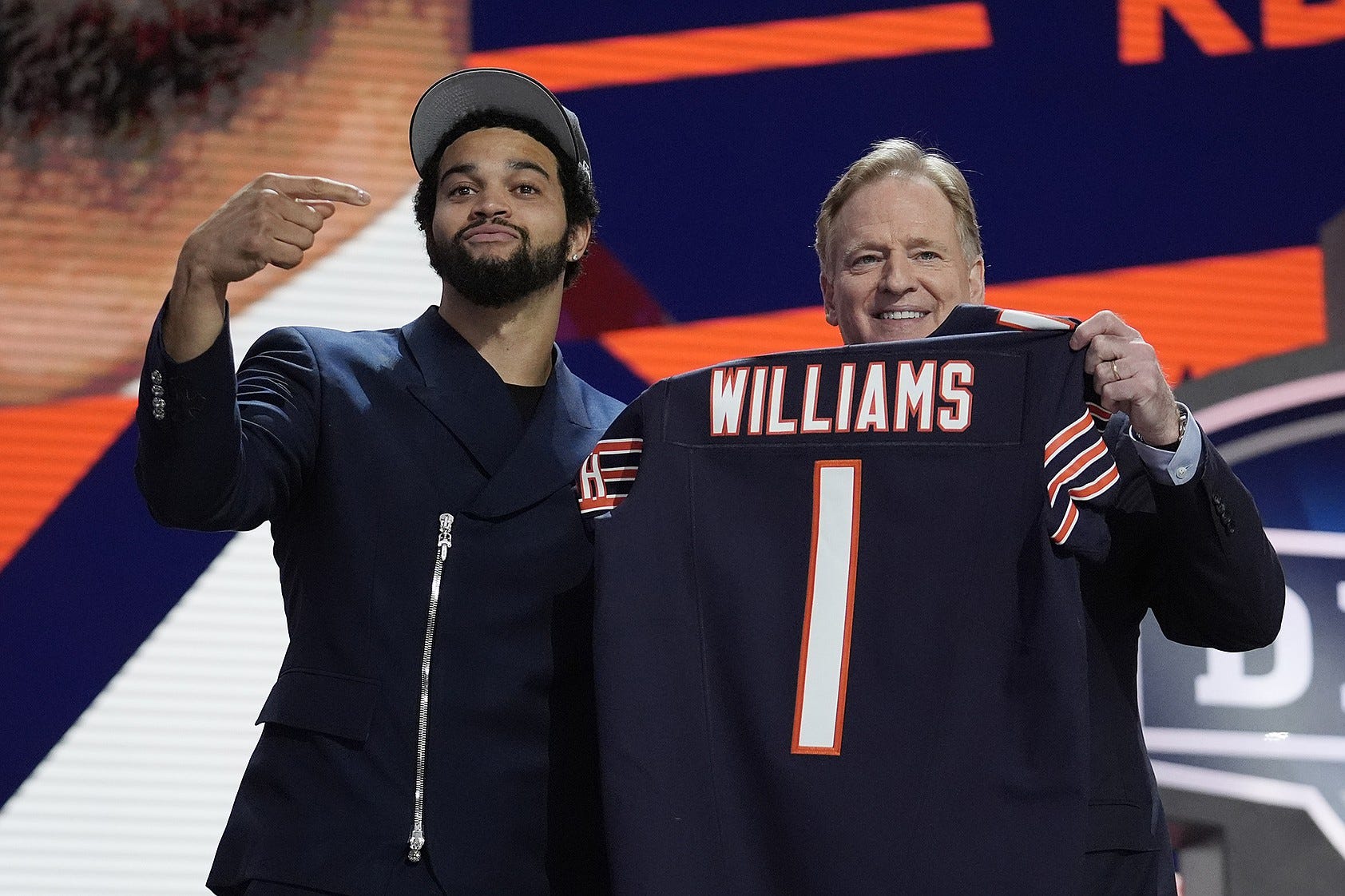
One year later, Williams turned pressure situations into a strength. The Bears improved from a 5-12 record to 11-6, securing their first division title since 2018. Williams was largely responsible for Chicago’s accomplishments in the 2025-26 NFL season.
This was not a gradual improvement, but a complete transformation within one year.
Conventional wisdom suggests elite quarterback prospects require several seasons to adjust to the NFL. Williams’ second-year transformation challenges this belief. The data shows that with effective coaching and the right system, elite prospects can transition from college success to NFL proficiency much faster than previously assumed.
Three transformations prove this argument:
Pressure situations shifted from a significant weakness to a strength
Execution in critical situations improved significantly
Showed elite potential in the postseason
Williams’ development in his second NFL year was not always linear, but he demonstrated sufficient talent and potential to lead the Bears to their first division title in seven years.
Section 1: From NFL’s Worst Under Pressure to Top-Tier Composure
The Rookie Disaster
The 2024 numbers quantified a quarterback drowning in NFL complexity:
Completion % under pressure: 8.65% (45th of 46 QBs)
Sack rate: 10.69% (44th of 46 QBs)
68 sacks in 636 dropbacks
Time to throw: 2.39 seconds (league average: 2.38)
The time to throw statistic refutes the idea that Williams held the ball too long; he processed plays at a league-average speed. The primary issue was execution. When the pocket collapsed, he struggled to respond. Three games illustrate these challenges: seven sacks against Houston in Week 2, a franchise-record nine sacks at New England in Week 10, and a loss to fellow rookie Jayden Daniels, sealed by a Hail Mary in Week 8.
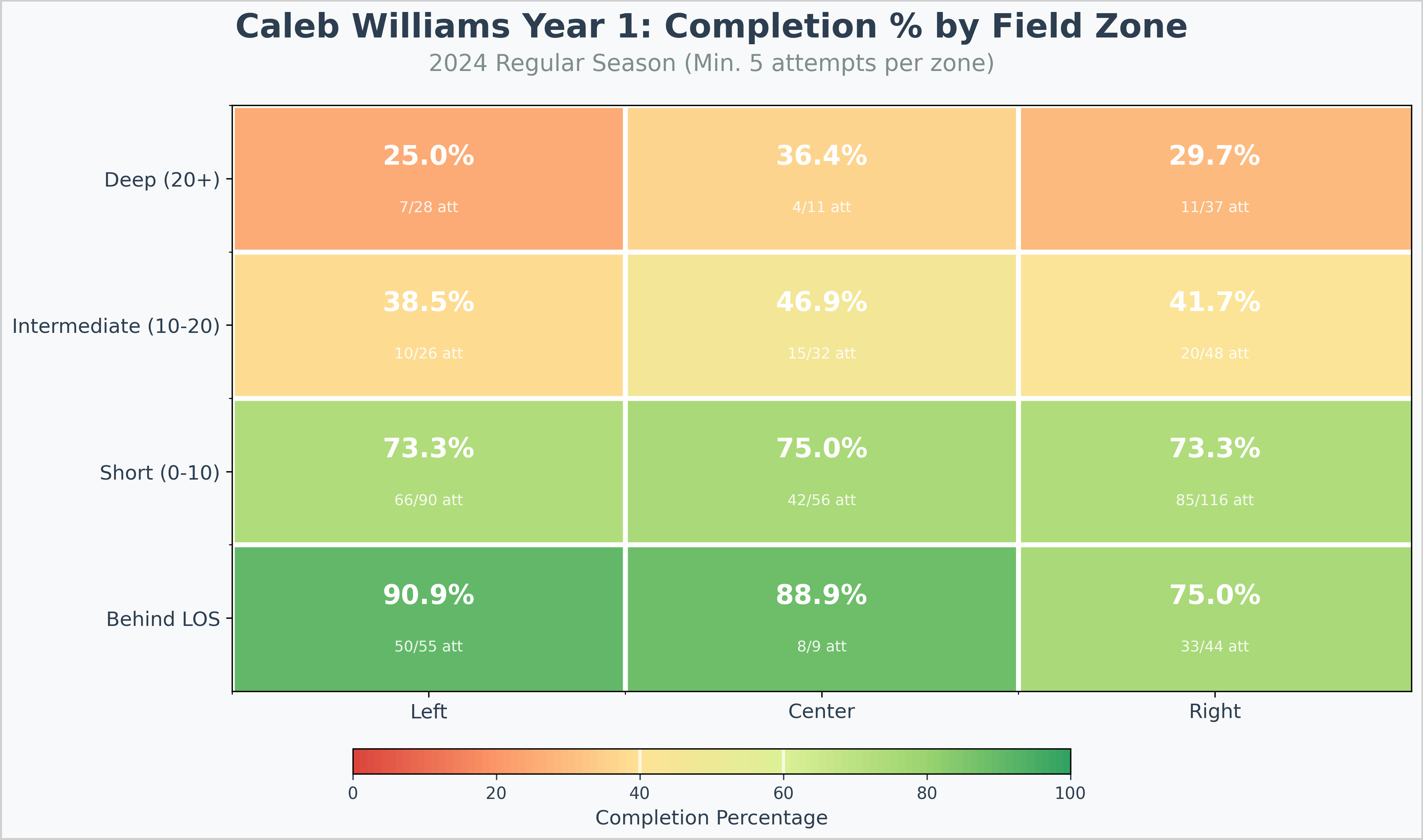
A 10.69% sack rate combined with an 8.65% completion rate under pressure resulted in frequent stalled drives. When defenses disrupted his rhythm, plays consistently failed.
The Year 2 Revolution
The 2025 transformation represents one of the largest single-year improvements in modern NFL history:
Completion % under pressure: 25.32% (+16.67%, 18th in NFL)
Sack rate: 3.64% (-7.05%, 2nd best in NFL)
Turnover-worthy play rate: 2.53% (-1.32%, 10th of 45 QBs)
EPA per play (clean pocket): 0.183
Deep ball accuracy (20+ air yards): 37.86% (12 TDs on 103 attempts)
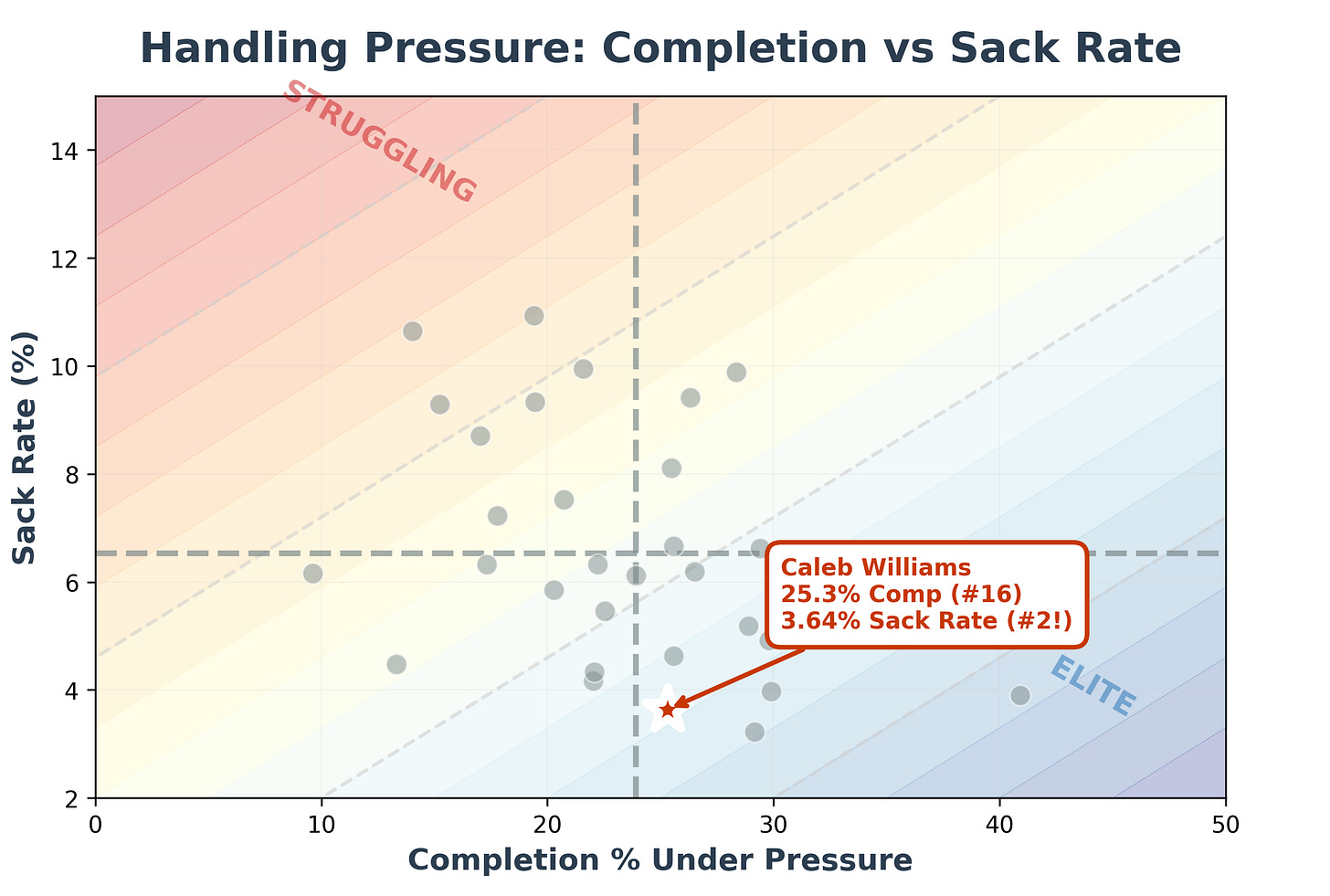
Williams’ Completion Percentage To Sack Rate Relationship in Comparison with Other Quarterbacks in 2025
The 16.67-percentage-point increase in completion rate is significant, but the improvement in sack rate is even more notable. Williams advanced from 44th to second in the league within one season. While the offensive line’s pass block win rate improved from 75.07% to 85.87%, the primary factors were Williams’ quicker decisions, enhanced pocket awareness, and increased confidence under pressure.
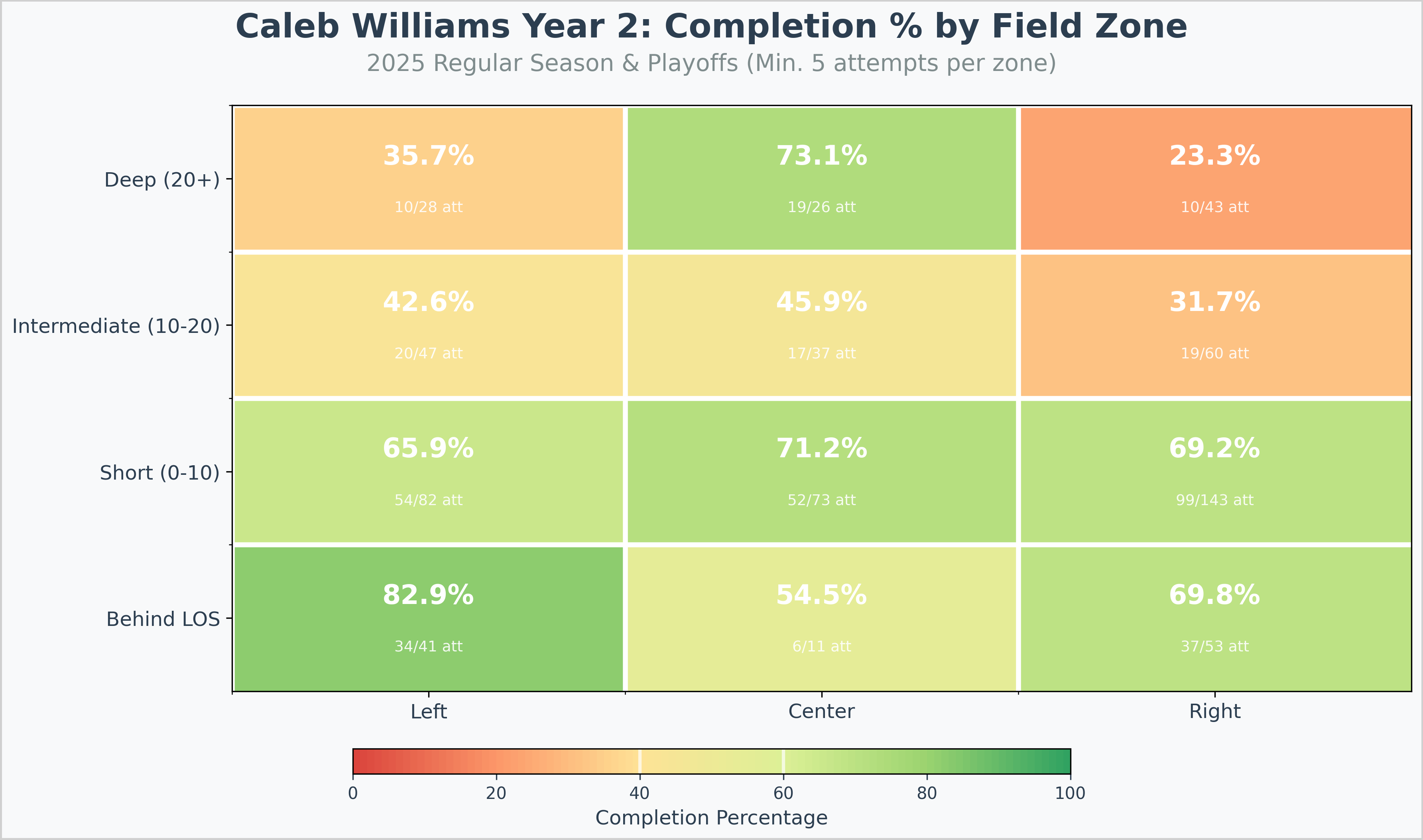
An improvement of over 10 percentage points in deep ball accuracy demonstrated Williams’ renewed willingness to target downfield. With adequate protection, he was highly effective in vertical passing situations.
The bottom line:
The quarterback who couldn’t function under pressure became one of the NFL’s best at avoiding sacks and maintaining completion efficiency when defenses collapsed the pocket. This transformation alone validates the argument that elite prospects can develop rapidly under proper coaching.
Section 2: Critical Situations Excellence
Pressure performance defines survival. Situational football (third downs, red zone, two-minute drills) defines championship contenders, and illustrates a quarterback’s clutch factor and their ability to win games in the toughest moments.
Third Down Mastery
Williams’ third-down transformation turned drives into points:
Conversion rate: 30.54% (2nd worst) → 38.78% (9th)
EPA on 3rd down: -0.3337 → +0.0463
Aggressive throw rate (3rd & medium/long): 26.67%
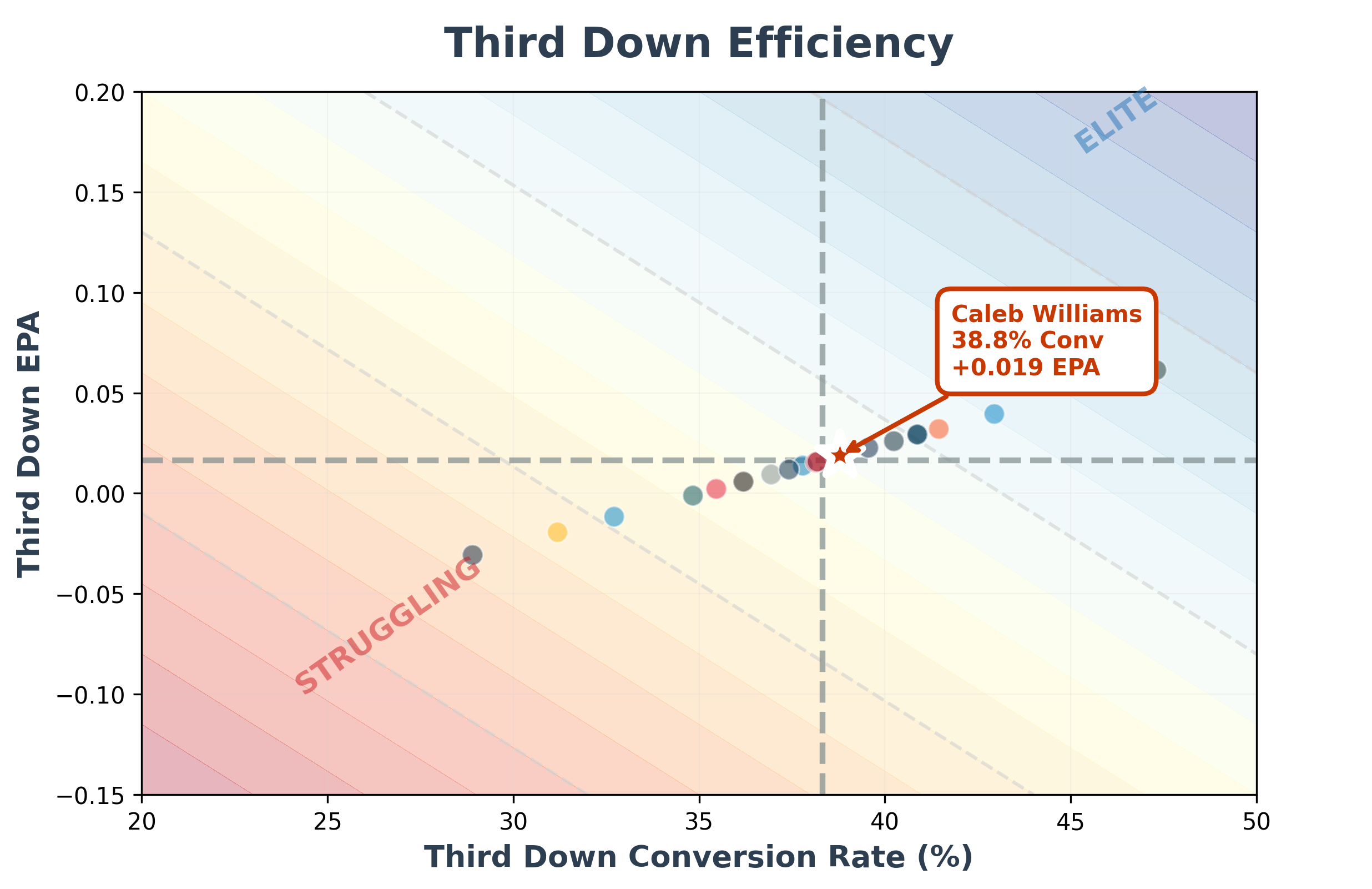
The 8.24-percentage-point jump vaulted Williams from second-worst to elite territory. His EPA swing from -0.3337 to +0.0463 quantified how drives now extended instead of dying when defenses knew he had to throw. The 26.67% aggressive throw rate showed a quarterback willing to attack vertically rather than checking down in fear.
Red Zone Improvement
Red zone efficiency separates field goal offenses from touchdown machines:
TD rate inside 20: 13.68% (44th) → 16.95% (39th)
Consecutive red zone attempts without INT: 35+
Average passer rating in red zone: 98.34
The Bears became less reliant on field goals as Williams improved his execution in the red zone. His streak of over 35 consecutive red-zone attempts without an interception highlights better decision-making and increased confidence in challenging tight coverage.
Two-Minute Drill Evolution
Championship quarterbacks thrive when the clock is their enemy:
Drives ending in points: 14.29% → 35.29% (13th of 45)
Game-winning or game-tying drives: 4
Points scored (final 2 min): 1.68 per game (29th)
The number of drives ending in points more than doubled. Williams led four game-winning or game-tying drives, demonstrating qualities that distinguish franchise quarterbacks. His performance in two-minute drills showed improved processing speed and composure under pressure.
The Ben Johnson Effect
New head coach Ben Johnson’s scheme evolution unlocked Williams’ potential:
Play-action usage: 24.36% → 28.63%
Empty formation EPA: -0.1346 → +0.1315 (Δ: +0.2661)
Pressure rate allowed: 24.93% → 14.13%
Johnson restructured the offense to leverage Williams’ strengths and address his weaknesses. As a result, the Bears improved from 28th to 9th in points per game and from 28th to 6th in total yards.
Section 3: Playoff Validation: Proving It When Championships Matter
Regular-season improvements require postseason validation. Williams delivered strong performances when it mattered most.
Regular Season vs Playoffs:
EPA per dropback: 0.0715 → 0.1495 (+0.0780)
Third-down conversion rate: 38.78% → 47.83%
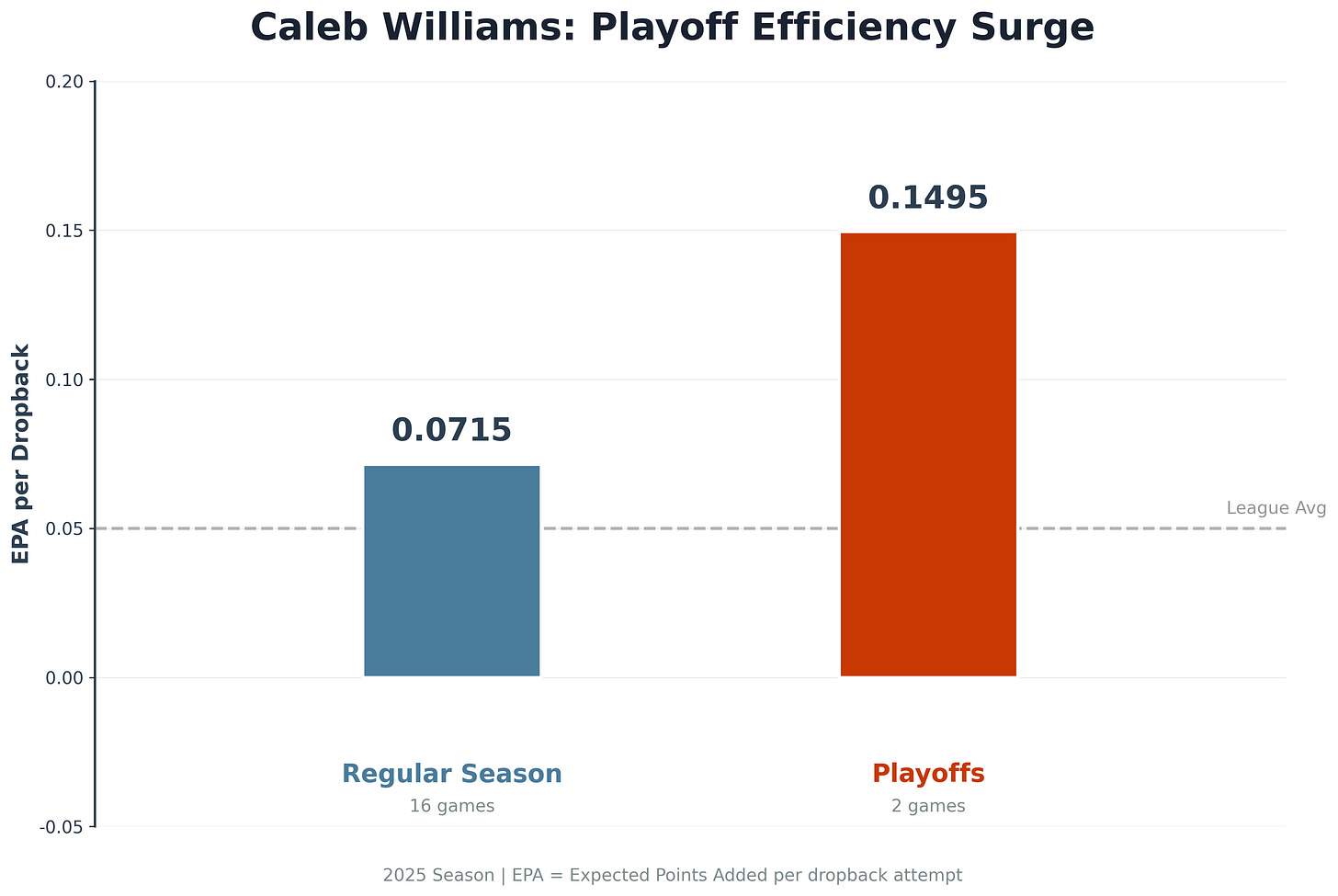
Caleb William’s EPA Comparison between the Regular Season and Postseason
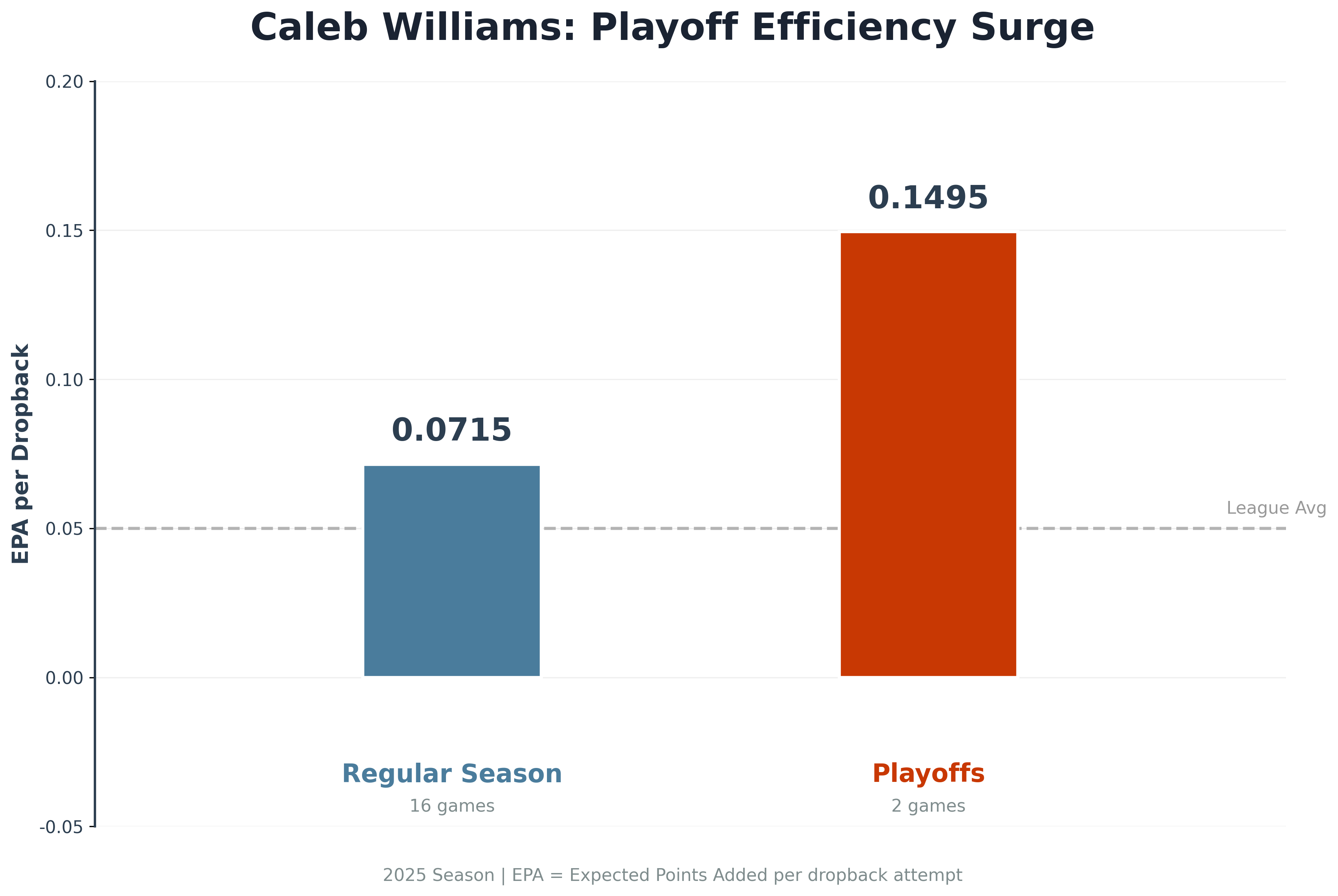
Williams’ EPA per dropback increased by 0.0780 in the playoffs, demonstrating his ability to perform under pressure. His third-down conversion rate also rose to 47.83% during the postseason.
Wild Card Round vs Packers: Down 21-3 at halftime at Soldier Field, the season appeared over. Williams threw for 184 yards in the fourth quarter alone, orchestrating three touchdown drives. On fourth-and-8, he rolled left under pressure and delivered a laser to Rome Odunze. With 1:43 remaining, trailing 27-24, he found DJ Moore streaking down the left sideline for a 25-yard touchdown. Final score: 31-27. The biggest postseason comeback in franchise history.
Williams finished 24-of-48 for 361 yards, joining Kurt Warner as the only quarterbacks in NFL history to throw for 350+ yards and win their playoff debut.
NFC Divisional Round vs Rams: Trailing 17-10 with 27 seconds left, facing fourth-and-4 from the Rams’ 14-yard line, the season was dead. Williams took the snap, the pocket collapsed, and he backpedaled to nearly the 40-yard line with his back turned to the end zone. Then he planted, spun, and launched a prayer. The ball traveled 51.2 yards through the air, dropping perfectly into Cole Kmet’s arms in the end zone. Tie game. Overtime.
Although the Bears lost in overtime 20-17, that 51.2-yard throw under heavy pressure established Williams as a proven playoff performer.
Conclusion: Rethinking Quarterback Development Timelines
Conventional thinking about quarterback development requires reconsideration. The belief that elite prospects need three to four years to reach playoff-level performance is outdated. Caleb Williams progressed from a historically low completion rate under pressure to one of the NFL’s best at avoiding sacks in a single season.
The data demonstrates three key points: pressure situations can become strengths within one year with effective coaching; situational execution in areas such as third downs, red zone, and two-minute drills can improve from league-worst to elite with optimized schemes; and playoff performance confirms these transformations, as shown by Williams’ record-setting comebacks and exceptional plays.
This transformation was not due to luck, but rather the combination of elite talent, effective coaching, and a suitable system. Ben Johnson’s scheme adjustments, improved offensive line performance, and Williams’ enhanced processing speed enabled rapid development. The 0.157 EPA per dropback improvement (from -0.06 to 0.082) quantifies Williams’ shift from reducing to creating offensive value.
The fourth-and-4 pass to Cole Kmet, covering 51.2 air yards under heavy defensive pressure, exemplifies this transformation. The former Heisman Trophy winner has yet to fullfill his potential, but showed he can be elite in this league.
Elite quarterback prospects do not require three years to develop anymore; they need one year with the right coach, the right system, and the confidence to perform in critical moments.
The Bears drafted Caleb Williams, hoping he’d become a franchise quarterback. The data proves he already is.
For anyone interested in underlying data and the analysis behind this article, sharing the GitHub Link Here