The Schedule Shift: The Most Underpriced Variable in Fantasy Drafts
WAY Too Early Guide To Win Your Fantasy Football League Next Year

When I talk with my league mates about what they look for in a draft pick, I hear the same things. Talent. Opportunity. Target share. Usage. Health history. Even if a player plays for their favorite team.
Almost nobody mentions schedule difficulty.
Last year I finished third. I narrowly chose Matthew Golden over Offensive Rookie of the Year Tetairoa McMillan. I watched Omarion Hampton go down in Week 5 and felt the season slip. I felt lucky to get third place, but this feat gets you nothing except an offseason of wondering what went wrong.
This spring I built ADP sheets, cross-referenced strength of schedule data, and looked at what changed for the players the market is mispricing. A pattern appeared: the names on my fade list are in situations that got harder in ways ADP hasn’t priced. The names on my buy list got easier in ways the market hasn’t caught up to. That’s a market inefficiency. Finding it is the difference between third and first.
The foundational distinction: situation vs. talent
Fantasy managers conflate two things: talent and situation. Talent is what a player can do. Situation is the system, the schedule, the teammates, and the health context around him. Both drive fantasy production, but only situation changes dramatically between seasons, and only talent is reflected in ADP.
When a running back puts up elite efficiency numbers over four healthy games then gets injured, his talent is what the tape shows. The market prices the injury and moves on. A situation-adjusted lens sees a player whose talent was real and whose situation just got better. The inverse: a quarterback finishing MVP runner-up on the AFC’s softest schedule with an efficiency number that almost never repeats is a player whose situation was doing real work. ADP prices the results, not what produced them.
The Buys
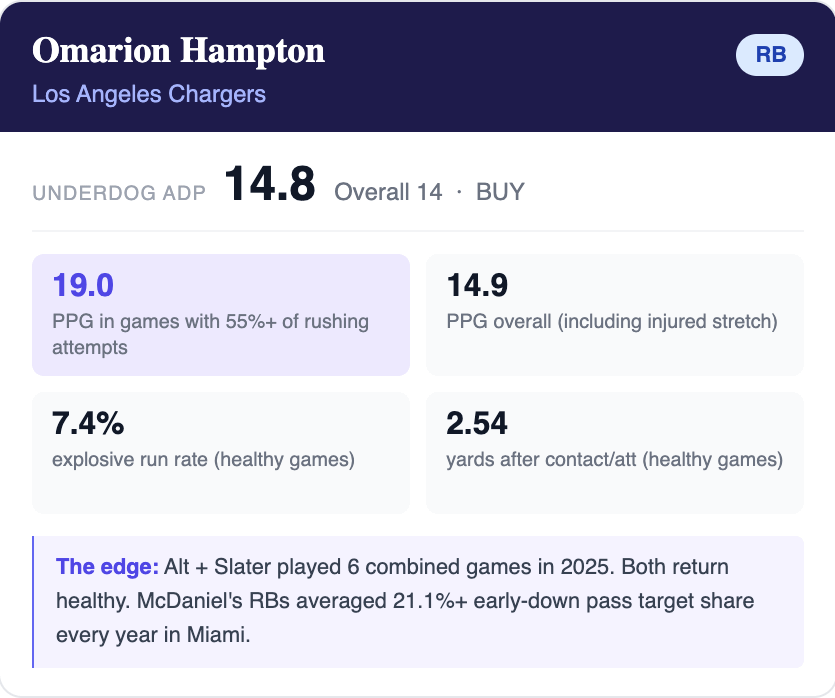
Omarion Hampton, RB, Los Angeles Chargers (ADP: 14)
I had Hampton last year and watched that Week 5 injury in real time. In his four healthy games, he was the RB13 in fantasy points per game: 17 touches and 95 total yards per game, a 7.4% explosive run rate, and 2.54 yards after contact per attempt. Per Fantasy Points Data, sustaining that pace would have ranked him fourth and eighth respectively among qualified backs in those categories.
Three things change this year: Joe Alt and Rashawn Slater return healthy after combining for just six games in 2025, the interior line was rebuilt, and Mike McDaniel arrives as offensive coordinator. McDaniel’s Miami offenses got De’Von Achane to 238 carries, 67 receptions, and 1,838 combined yards in a featured role. The market has Hampton as a top-ten back. The situation says top-five.
Tyler Shough, QB, New Orleans Saints (ADP: 121)
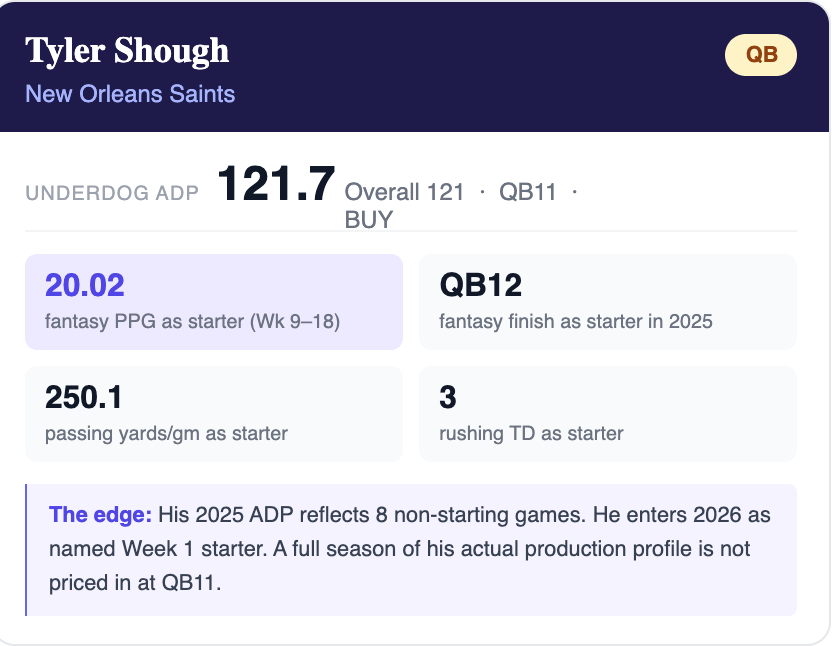
Buying a quarterback doesn’t mean taking him early. It means not leaving him on the wire when he’s QB12-caliber production going as QB19.
From Week 9 onward last year, Shough averaged 250.1 passing yards and 19.3 rushing yards per game with three rushing touchdowns. He enters 2026 as the named starter with Chris Olave, Travis Etienne, and rookie Jordyn Tyson. Coach Kellen Moore’s offense ranked first in pace of play, which inflates counting stats regardless of efficiency, and the Saints carry the second-easiest schedule in the league. That combination at QB19 is value hiding in plain sight.
Isaiah Likely, TE, New York Giants (ADP: 131)
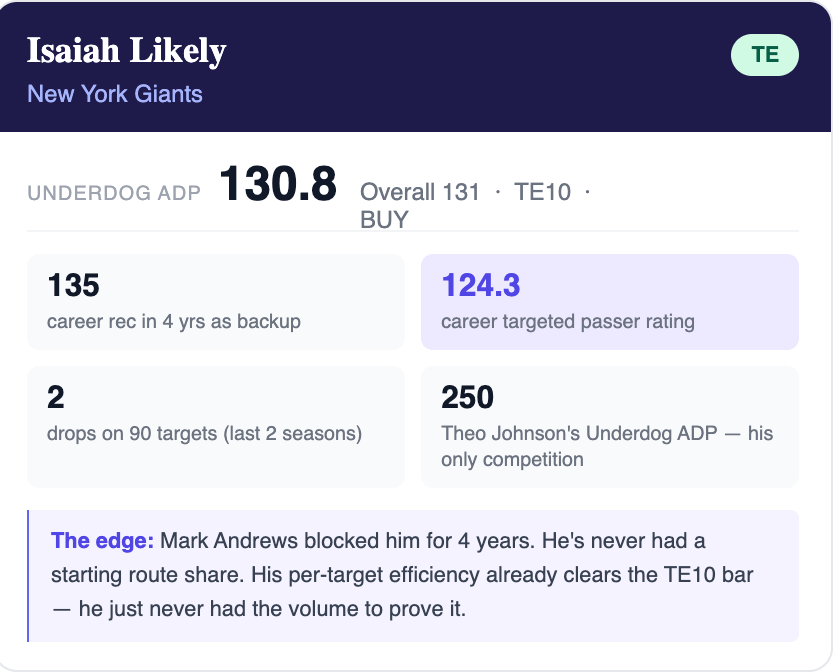
This one is personal. I’m a Giants fan, and Likely signing with New York on a three-year, $40 million deal was the move I didn’t know I needed.
For four years in Baltimore, Mark Andrews prevented Likely from getting volume. In that time he still produced 135 receptions, 1,568 yards, and 15 touchdowns, dropping just two of 90 targets over two seasons with a career targeted passer rating of 124.3. That constraint is gone. He enters New York as the lead tight end with Theo Johnson as his only competition. TE15 is priced on Baltimore. The situation is someone who has never had a real route share and is about to get one.
The Fades
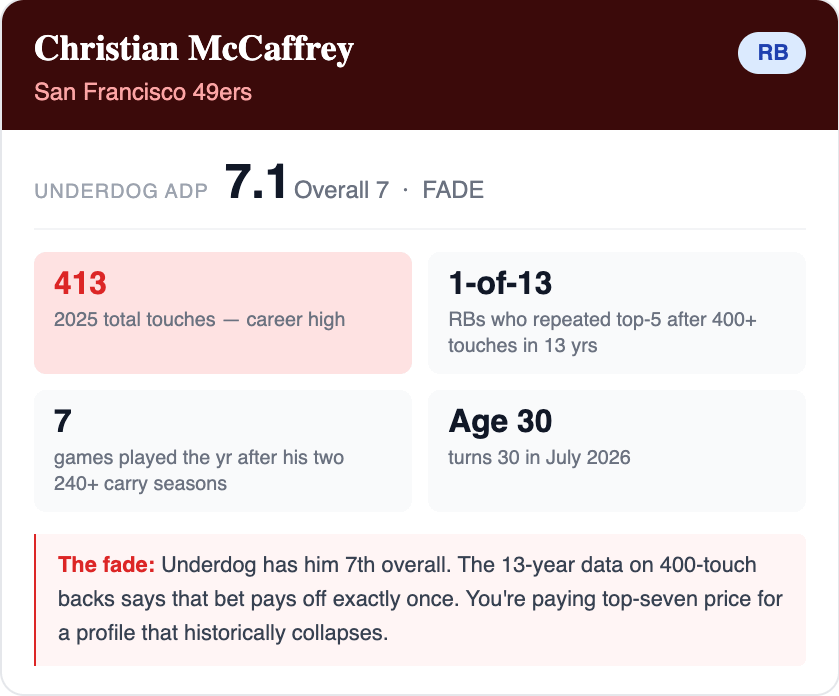
Christian McCaffrey, RB, San Francisco 49ers (ADP: 7)
Fading McCaffrey is not a talent argument. He was the clear RB1 last year: 2,126 scrimmage yards, 17 touchdowns, 17 games. The argument is about what the data says happens after a workload like that.
In the last 13 years, running backs who received 400-plus touches went on to finish as a top-five fantasy back the following year exactly once. McCaffrey just had a career-high 413. That same sample averaged 12.6 games played and 18.0 fantasy points per game the season after. He turns 30 this summer, and in his two previous seasons with more than 240 carries, he played a combined seven games the following year. The super variable is mileage, not talent.
Drake Maye, QB, New England Patriots (ADP: 67)
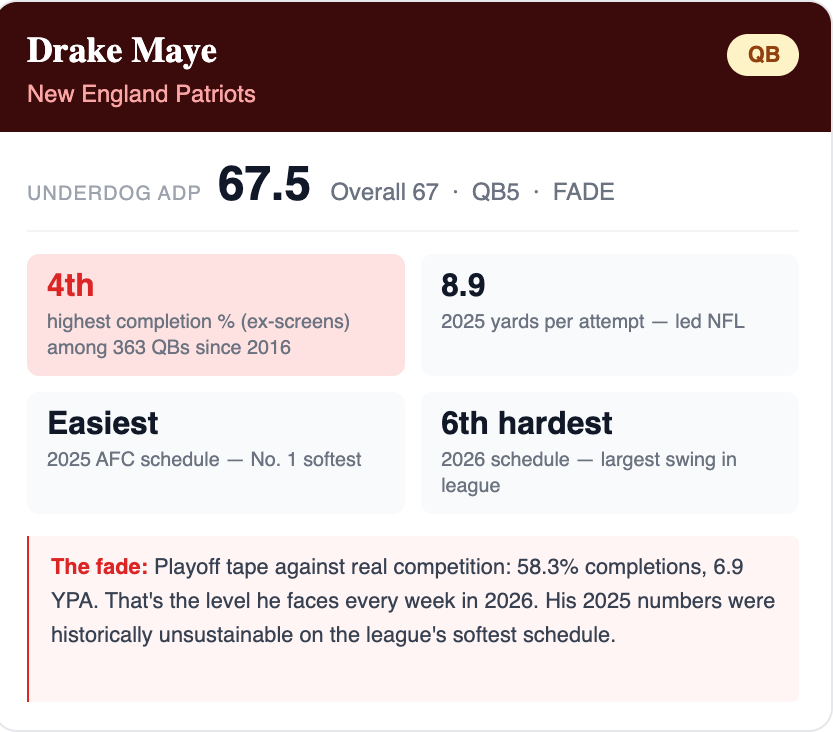
Maye finished as MVP runner-up and QB2 in fantasy last year: 21.1 points per game, 72.0% completions, 8.9 yards per attempt, 113.5 passer rating. The Patriots added A.J. Brown and Romeo Doubs this offseason.
The variable the market isn’t pricing: last year the Patriots played the AFC’s easiest schedule. This year they face the sixth-toughest in the NFL. Any regression in his 8.9 yards per attempt compounds against a harder schedule rather than a soft one. His playoff tape tells the story: 58.3% completions, 207 passing yards per game, 6.9 yards per attempt against the league’s best defenses. That is now the regular season competition level.
Zay Flowers, WR, Baltimore Ravens (ADP: 31)
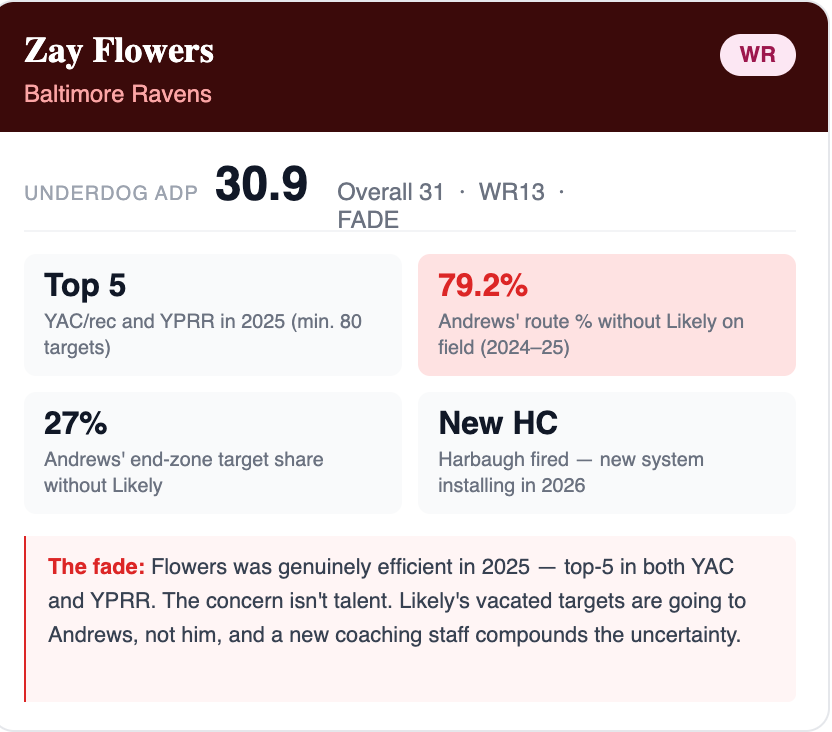
Likely’s departure sounds like good news for Flowers. But in the four games Andrews played without Likely since 2024, Andrews ran 79.2% of the team’s routes and accounted for 27% of Baltimore’s end zone targets.
The vacated production went to the tight end. A new coaching staff and an inconsistent Jackson after Week 8 compound the uncertainty. The constraint on Flowers is not ability. It is whether this offense will be stable enough for his targets to consistently translate into fantasy points.
Putting it together
Third place finishes because it drafts names. First place finishes because it drafts situations. Every pick on this list, every buy and every fade, comes back to the same underlying logic: the market is looking at what a player did last year, and I am looking at the conditions he is walking into this year. Those two things are not the same, and the gap between them is exactly where I expect to find the edge that moves me from third to first. August will tell us if I am right.
Key takeaways
The situation-talent gap is the only inefficiency that resets every offseason. Talent is stable. Situations change. ADP prices last year. Draft this year.
Schedule difficulty is not a tiebreaker. The Patriots went from the AFC’s easiest schedule to the sixth-toughest in one offseason. That is not context. That is the argument against Maye at QB4.
The 400-touch rule is the most reliable regression signal in fantasy football. One top-five finish in 13 years among backs who hit that threshold. McCaffrey just crossed it at age 29.
Volume constraint removed is not the same as talent improved. Hampton, Burden, and Likely were already producing at elite per-opportunity rates. Their situations just stopped punishing them for it.
Fading is a pricing argument, not an ability argument. McCaffrey and Maye are good players. The fade is about what their ADP implies versus what their situation now suggests they will actually deliver.